
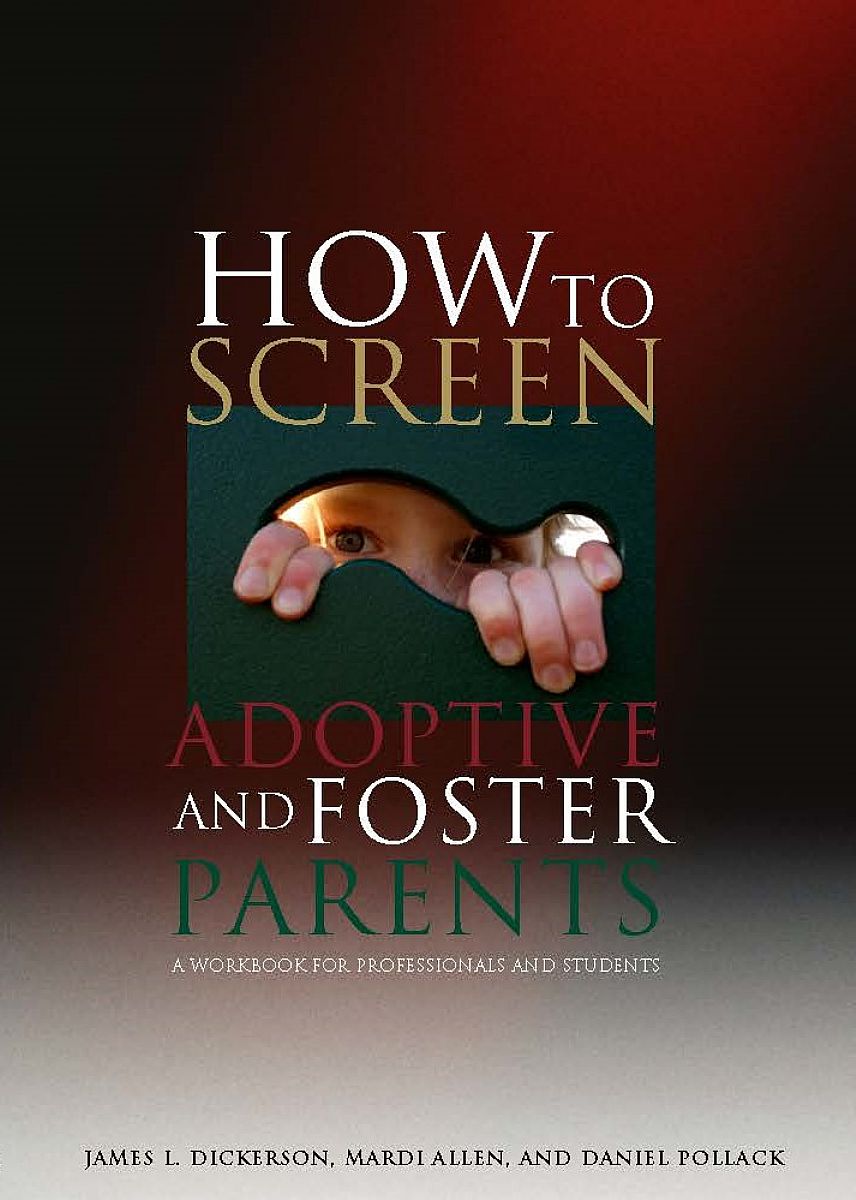
How to Screen Adoptive and Foster Parents
A Workbook for Professionals and Students
Authors: James L. Dickerson, Mardi Allen, and Daniel Pollack
Page Count: 272
ISBN: 978-0-87101-415-3
Published: 2011
Item Number: 4153
$42.99
NASW members receive 10% discount on books and eBooks by entering their membership number at checkout.
Screening potential adoptive and foster parents is an extremely difficult task, yet many social workers who screen applicants and supervise placements have no written guide to aid in their decision making or to measure competency of technique.
How To Screen Adoptive and Foster Parents: A Workbook for Professionals and Students serves as a comprehensive guide for social workers to draw on when making decisions for foster care/adoption placement. Based on case histories, research data, and interpretive analysis, this workbook teaches specific interview skills and analytical decision-making techniques necessary to competently evaluate each unique applicant family within a variety of constructs. Comprising 12 concise and well-researched chapters, this guide is ideal for both classroom discussions and real-life applications.
About the Authors
Acknowledgments
PART 1: Interviewing
Chapter 1: What You Need to Know Before You Begin Interviews
Chapter 2: First Contact: The Do’s and Don’ts
Chapter 3: What You Need To Know About Follow-Up Questions
Chapter 4: The Individual Interview
Chapter 5: Screening for Child Predators
Chapter 6: Using Health and Reference Information as a Screening Device
Chapter 7: Screening for Positive and Negative Parenting Attitudes
Chapter 8: Applying the Foster Parent Syndrome
Chapter 9: Understanding Your Legal Obligations
Chapter 10: How to Make Recommendations to a Supervisor
PART 2: Psychological Assessment
Chapter 11: The Power of the Question: When to Consult Psychologists During the Home Study Process
Chapter 12: Psychological Consultations: When Parents Have Mental Health Problems
Appendix
Glossary
References
Additional Reading
Index
Social workers and other professions dealing with the placement of children in foster and adoptive care have an enormous responsibility as their decisions and recommendations have lifelong consequences both for the children concerned, as well as for the families in which the children are placed.
The book begins with some statistics on the outcomes of placements that should make practitioners very aware of the consequences of inadequate investigation, poor decision making with regard to placements and the follow up care of children.
Subsequent chapters contain very practical information, and suggestions about numerous aspects of the screening process for foster and adoptive care, inclusive of checklists, forms and practical exercises.
Although written in the context of the U.S. child care and protection system, the book has much to offer professional social workers working in other countries who are involved in assessing families for the placement and care of children.
Joan van Niekerk
Manager, Training and Advocacy, Childline South Africa
—————————–
As a lawyer who advises child serving agencies, I highly recommend this book. It is useful as a risk-management tool, as a guide for developing policies and procedures, and for evaluating the quality of existing agency practices. Its depth of detail is extraordinary and its organization makes it very easy to use. If I could I would make sure that every agency employee associated with the “screening process” had their own copy. This is a “must have” book and will likely set the practice standards for evaluating foster and adoptive parents.
Harvey Schweitzer
Schweitzer & Scherr, LLC