
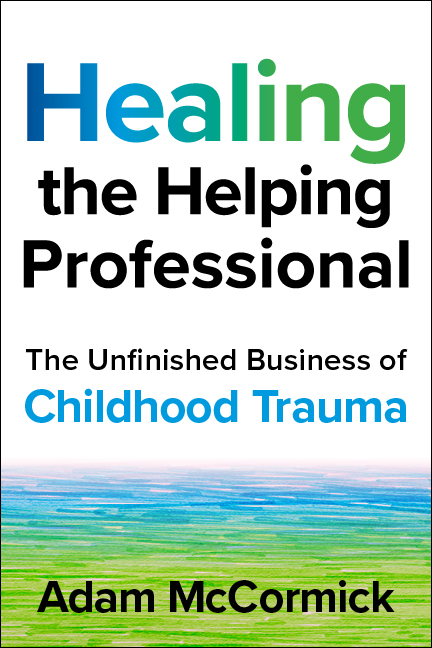
Healing the Helping Professional
The Unfinished Business of Childhood Trauma
Author: Adam McCormick
Page Count: 220
ISBN: 978-0-87101-637-9
Published: 2026
Item Number: 6379
Price range: $36.07 through $39.21
NASW members receive 10% discount on books and eBooks by entering their membership number at checkout.
Can your device download this eBook? Click here before purchasing! eBooks are available in single quantities only.
Earn 7.0 CEUs for reading this title! For more information, visit the Social Work Online CE Institute.
Hurt people help people.
For many social workers, the journey into the profession is deeply influenced by their own childhood experiences of trauma and adversity. These wounds—from neglect, abuse, domestic violence, and other traumatic experiences—often deepen the helping professionals’ capacity to empathize and sit with others in their most vulnerable and painful moments.
But what happens when you construct a career to flee a painful past? Influenced by their unresolved childhood trauma, many social workers unconsciously recreate those harmful dynamics in their professional roles. What was once a coping mechanism—such as people-pleasing, feeling indispensable, ignoring your own needs, or being the hero—could now be a maladaptation that exacerbates existing professional challenges like compassion fatigue, secondary traumatic stress, and burnout.
A healthier, more productive path is possible. For more than two decades during his work in child welfare, Adam McCormick has taught social workers about the ways children adapt in chaotic, lonely, and threatening environments. After discovering a link between helping professionals’ childhood wounds and their present work, McCormick began teaching trauma-informed care, self-care, and resilience to help them prioritize their needs and foster authenticity in their practice.
In Healing the Helping Professional: The Unfinished Business of Childhood Trauma, McCormick delves into the unspoken ways that trauma shapes the lives, work, and well-being of social workers and other helping professionals. Drawing on research, interviews, and his own difficult childhood, McCormick uncovers how early adverse experiences leave imprints on the nervous system, influence relational patterns, and often lead to careers in caregiving professions.
Using evidence-based practices, case studies, guided exercises, and reflection questions, McCormick aims to transform each helping professional’s narrative from one of self-sacrifice to one of sustainable self-care, regulation, and authenticity. Healing the Helping Professional creates a much-needed space for social workers to engage in their own healing, better equipping them to support their clients while maintaining their emotional well-being.
Acknowledgments
Introduction: Scared Animals Return Home
Chapter 1: Recreating the Familiar Dynamics of Childhood
Chapter 2: Attachment versus Authenticity
Chapter 3: Your Past as an Explanation and Not an Excuse
Chapter 4: The Authentic Social Worker versus the Adaptive Child
Chapter 5: The Fix Response: When Fighting and Fleeing Are Not Options
Chapter 6: Seen and Heard: The Power of Connection in Social Work
Chapter 7: When the Work Gets under Your Skin: Understanding the Neuroscience, History, and Hidden Costs of Emotional Contagion in Social Work
Chapter 8: The Wisdom of Trauma: A Framework for the Social Worker’s Posttraumatic Growth
Chapter 9: The Stories We Carry: Understanding the Narrative Nature of Childhood Trauma
Chapter 10: Holding the Story and Not Just the Role: Trauma-Informed Supervision in Social Work
Chapter 11: How Social Work Can Resurface Old Wounds
Annotated Bibliography
Index
About the Author
Earn 7.0 CEUs for reading this title! For more information, visit the Social Work Online CE Institute.
To hear an interview with the book’s author, Adam McCormick, listen to the podcast or watch the interview below!
Introduction: Scared Animals Return Home
Scared animals return home, regardless of whether home is safe or frightening.
—Bessel van der Kolk, The Body Keeps the Score: Brain, Mind, and Body in the Healing of Trauma
My study of family systems and introduction to social work started when I was a small child. Like his father before him, my own father was a man marked by deep wounds from an intensely traumatic childhood. The scars of my father’s childhood wounds were deeply imprinted in every aspect of how he treated my mother, my sister, and me. Rage, shame, and alcoholism were the ways that he adapted to his childhood wounds. Eventually, his shame led him to abandon our family when I was a teenager.
My own survival adaptations took on a much different form than those of my father. For much of my life, I saw myself as a cycle breaker. My achievements included a wonderful education, a successful career, and a loving family. My children experienced a childhood that was worlds apart from my own. My career as a social worker seemed like the ultimate proof that I had broken free from my family’s generational trauma. What better testament, I thought, than dedicating my life to healing wounds in others that were similar to those of my own childhood? Eventually, however, I came to realize that this “proof ” of a broken cycle was not as solid as I once believed. Even though my life looked entirely different from the one I had known as a child, trauma’s grip had a subtle but firm hold on my work and relationships.
At its core, trauma disconnects us from our authentic selves, pulling us back to the most painful and lonely memories of our childhood without us even knowing it. Healing begins only when we allow the past to loosen its grip. I had not broken the cycle like I always thought I had; instead, I had recreated some of the most familiar dynamics of my childhood. Ultimately, I would come to recognize a very similar pattern in the lives of many of my social work students and colleagues.
As an adult, my role as a social worker in the Texas foster care system mirrored the unpredictable chaos of my childhood home. As children, we create stories to make sense of our world, and often, we spend our lives working to corroborate these early narratives. For me, this story cast me as the family’s hero, striving to project an image of normalcy to the world, to my family, and to myself. This “hero” identity accompanied me well into adulthood, where I became a workaholic, people-pleasing social worker. My compulsion to say “yes” was deeply tied to my fear of not belonging. Attachment to my father was always elusive and conditional, requiring me to sacrifice my own needs for his. Social work offered the perfect setting for me to continue ignoring my own needs, as my focus turned to the most at-risk children and families in the foster care system.
As a child, I’d lie awake, trying to think about how I could make myself more important to my father than his alcohol. As an adult, I was kept awake by the reel of traumas presented by the kids and families on my caseload. I encouraged social workers to prioritize self-care and I tried to teach my own children to love and value themselves. Meanwhile, I couldn’t identify my authentic self if you asked me to pick it out of a lineup. How do you care for a self that died years earlier? My supervisors and colleagues never questioned where my workaholic tendencies and need to please stemmed from—most never considered the origins of their own. Suggestions for “self-care” and “setting boundaries” felt like asking a kindergartner to solve a trigonometry equation.
With no option to fight (a child cannot fight their father) or flee (where does a small child go?), I suppressed my fear and anger, taking on the role of a “fixer”—a trait I now see echoed in so many helping professionals. I would find a new home in one of the most chaotic and traumatic fields imaginable. Addressing the crises of traumatized children and families would become my new beat.
I went on to quickly earn a PhD, live in a foster group home caring for teenagers, run a large family service program, become a professor, have five kids, and celebrate my 20th wedding anniversary—all before I turned 40 years old. Kids who grow up playing sports or music become athletes or musicians; I, too, would thrive at the things I spent my childhood doing: people-pleasing and thriving in chaos.
My father’s wounds were numbed with alcohol, an addiction that ultimately took his life. My addiction, by contrast, was the need to be needed. Working in foster care offered a nearly limitless supply of children and families with the most acute needs. Giving me a social work degree and access to some of the most at-risk families was akin to giving a drug addict the keys to a pharmacy.
As Bessel van der Kolk notes, “Scared animals return home, regardless of whether home is safe or frightening.” My calm, selfless, empathic demeanor was more a reflection of a disconnection from my most authentic self than a reflection of my most genuine qualities. This profession—where selflessness is often considered the ultimate virtue—only confirmed my childhood narratives that validation and belonging required me to outwork everyone else, neglect my own needs, and take up as little space as possible. The adaptations that I needed to survive my past would become the portal that kept taking me right back to it. Though I had not seen my father in decades, I organized my life as if he were still there, sitting on my front doorstep.
For over two decades, I have taught social workers about the ways children adapt to survive and preserve attachments in chaotic, lonely, and threatening environments. After every class or community workshop, someone inevitably approaches to share a story, ask a question, or reflect on how the material resonates with them. While these conversations sometimes center on the children and families they work with, they more often reveal something deeply personal about their own childhoods. With a deep curiosity, many ask me how their own childhood wounds may manifest in their work, often expressing frustration with the field for not better equipping them with the answers to these questions. I realized, however, that despite studying the effects of childhood trauma for decades, I, too, didn’t have a clear answer for them.
Many social workers I’ve known over the years have very intentionally constructed lives, careers, and relationships that look nothing like those they grew up with. Much of their energy has been directed toward fleeing their painful pasts, finding healthier ways to parent, partner, and work that feel worlds apart from what they knew in childhood. Yet, despite these efforts, the adaptations that once helped them survive and connect in childhood have often grown up with them, shaping their adult behaviors and professional identities in ways they are not aware of. For some, the personality traits and professional qualities they cherish most are, in reality, a reflection of the survival adaptations that they developed to survive and attach in childhood. Many coping mechanisms that were once perfectly adaptive for surviving childhood have become deeply maladaptive in their work as adults. As acclaimed author and relationship specialist Terry Real (who also writes as Terrence Real) often says, “Adaptive then, maladaptive now.”
Throughout this book, I explore how trauma convinces us that our experiences are unique and isolating. I have seen this firsthand in social workers who have shared their childhood stories of hurt, unpredictability, and loneliness. Without language for their experiences, they often struggle to link these early painful experiences to the dynamics that define their current relationships and professional lives. Many engage in a form of wound comparison, convincing themselves that their own traumas pale in comparison to the traumas of their clients, leaving their wounds unhealed and their adaptations unaddressed. Like me, some have come to think of their survival adaptations as their greatest strengths: The selflessness, people-pleasing, emotional intuition, professional heroism, and hyperresponsibility they relied on as children often define their adult and professional identities. These are also the traits that happen to make them great social workers. These traits, once essential to survival and belonging, are often praised and rewarded professionally in many of the same ways that they were in their families growing up.
For the past three years, I have been on a journey to help social workers better understand the connection between their own childhood wounds and their professional work. I have had the privilege of sitting with dozens of social workers from various fields, working with them to help them find the language that links their personal childhood experiences to the dynamics shaping their adult relationships and their roles as social workers. The stories I have heard from social workers have opened my eyes to how deeply these early wounds imprint on the lives of those who carry the weight of helping others heal. These stories have helped me, too, to better understand why so many social workers struggle to prioritize their needs and care for themselves in sustainable ways. My purpose in writing this book is to share these stories to help other social workers understand where these imprints show up in their lives and to foster a new, more authentic way of relating to themselves and to their work. Names have been changed to protect identities. I hope this book serves as a tool for excavating and understanding the ways our pasts impact our work—honoring the adaptive nature of our behaviors while shedding light on how some of them have worn out their welcome.
If you often say “yes” when a fair and healthy “no” is screaming to be heard, this book may be for you. If you are a people pleaser with a deep need to feel needed by others, this book may be for you. If you find it hard to be “OK” unless everyone else is “OK,” this book may be for you. If setting boundaries with clients or colleagues is a struggle because boundaries once felt threatening, this book may be for you. If you played the role of the family hero to try and convince yourself and others that things were normal when they were not, this book may be for you. If you have an almost compulsive concern for the needs of others while often ignoring your own needs, this book may be for you. If you are someone who is adept at recognizing and tending to the wounds of others, yet find yourself unaware of the deep imprints of your own, this book may be for you. And if you feel disconnected from the most authentic parts of yourself—if you had to leave parts of yourself behind in order to survive and now wonder which parts are truly you—then this book may be exactly what you need.