
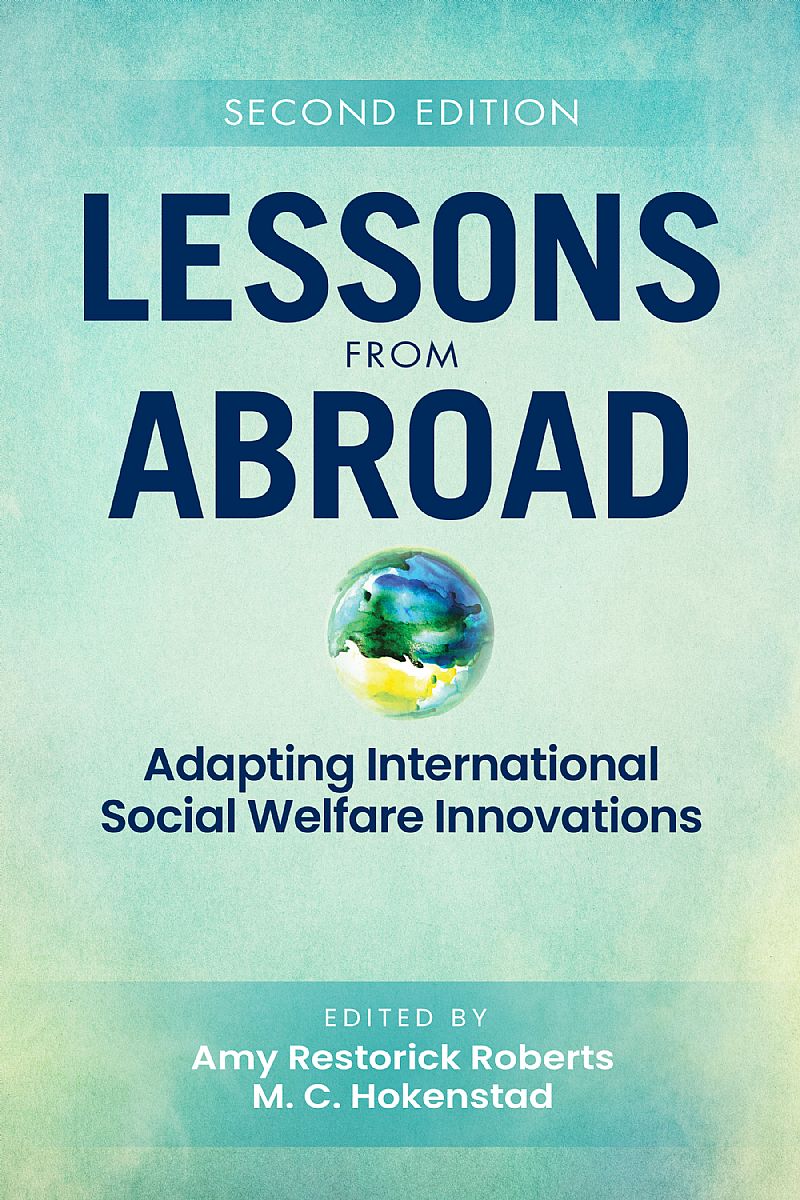
Lessons from Abroad, 2nd Edition
Adapting International Social Welfare Innovations
Editors: Amy Restorick Roberts and M. C. Hokenstad
Page Count: 204
ISBN: 978-0-87101-578-5
Published: 2022
Item Number: 5785
Price range: $42.21 through $44.43
NASW members receive 10% discount on books and eBooks by entering their membership number at checkout.
Can your device download this eBook? Click here before purchasing! eBooks are available in single quantities only.
Earn 6.5 CEUs for reading this title! For more information, visit the Social Work Online CE Institute.
There is much to learn through the international exchange of policy initiatives and program models. “Lessons from abroad”—the knowledge of problem-solving programs in other countries—can be an important component of understanding and addressing social problems in the 21st century United States, inspiring and informing policy action and program development.
Editors Amy Restorick Roberts and M. C. “Terry” Hokenstad bring together top scholars who share their expertise about approaches for understanding and addressing an array of global challenges through policy and practice examples from both developing and developed countries. Chapters examine distinct content areas, such as child welfare, aging, the climate crisis, and forced migration. Other chapters more broadly address global issues directly aligned with the values and professional ethics of social work, including environmental justice, the alleviation of poverty, social security, and community development. One chapter is devoted to the international social welfare treaties and conventions that affect social welfare and social work practice around the world, and the final chapter provides a thoughtful review of the United Nations Sustainable Development Goals and discusses the 2030 Agenda, examining implementation strategies and the contributions of social work.
Introduction: Global Challenges and International Innovations: Social Policy and Program Models from Other Countries
M. C. “Terry” Hokenstad and Amy Restorick Roberts
Chapter 1: Forced Migration, Displaced Persons, and Our Climate in Crisis: A Call for Environmental Justice in Social Work Education and Practice
Rebecca Leela Thomas
Chapter 2: Exploring Child Welfare through International Innovations
Rosemary J. Link
Chapter 3: Age-Friendly Cities and Communities: An International Network of Innovation and Exchange
Amy Restorick Roberts and M. C. “Terry” Hokenstad
Chapter 4: Global Trends in Social Protection: Lessons for the United States
James Midgley
Chapter 5: Global Migration and Promising International Innovations
Uma A. Segal
Chapter 6: Community-Based Psychosocial Support: Lessons from the Global South
Martha Bragin
Chapter 7: Global Trends in Community Development: Lessons for the United States
Michelle Livermore
Chapter 8: International Social Welfare Treaties and Conventions: Implications for the United States
Elizabeth Lightfoot
Chapter 9: United Nations 2030 Agenda for Sustainable Development: The Social Work Role
Lynne M. Healy and M. C. “Terry” Hokenstad
Index
About the Editors
About the Contributors
Amy Restorick Roberts, PhD, MSSA, is an associate professor of social work at Miami University in Oxford, Ohio, and a research fellow at the Scripps Gerontology Center. She has served on the Council on Social Work Education’s Commission on Global Social Work Education, as well as other committees that support programs and research in the areas of international education, human rights, and global aging. Roberts teaches courses in social policy, gerontological social work practice, and human behavior in the social environment at both the undergraduate and graduate levels. She has worked in the area of gerontological social work for over 20 years as a practitioner, researcher, and educator. Her articles have been published in International Social Work, the Journal of Gerontological Social Work, The Gerontologist, Medical Care Research and Review, Research on Aging, the Journal of Social Work Education, and other journals. In recognition of her scholarship that aims to improve the quality of life of older people and strengthen systems of long-term care services and supports, Roberts was recognized as a fellow within the Gerontological Society of America in 2018. Her current research projects examine social work in nursing homes, family caregiving, and preventing elder abuse.
M. C. “Terry” Hokenstad, PhD, is Ralph and Dorothy P. Schmitt Professor Emeritus at the Jack, Joseph, and Morton Mandel School of Applied Social Sciences and professor of international health in the School of Medicine at Case Western Reserve University, Cleveland, Ohio. He is a recognized international leader in social work, having served on many international committees and commissions. He has been editor of International Social Work and has also published widely on international issues. His major books include Participation in Teaching and Learning: An Idea Book for Social Work Educators (with Barry Rigby), Linking Health Care and Social Services (with Roger Ritvo), Gerontological Social Work: International Perspectives (with Katherine Kendall), Profiles in International Social Work (editor with S. K. Khinduka and James Midgley), and Issues in International Social Work (editor with James Midgley). He has received two Fulbright Awards for teaching and research in Scandinavia and has been a visiting professor and program consultant at several universities in Europe and Asia. Hokenstad is a past president of the Council on Social Work Education in the United States and is currently honorary president of the Global Institute of Social Work, which is headquartered in Singapore.
Martha Bragin, PhD, MSW, is jointly appointed professor at the Silberman School of Social Work at Hunter College and the PhD Program in Social Welfare at the Graduate Center of the City University of New York. She joined the faculty after 30 years of experience supporting United Nations agencies, governments, and nongovernmental organizations to address the effects of violence and disaster on children, youth, and families. She serves as a member of the Inter-Agency Standing Com-mittee Reference Group on Mental Health and Psychosocial Support in Emergency Settings that sets and monitors standards for psychosocial interventions by all humanitarian actors in emergencies. Representing the International Association of Schools of Social Work at the United Nations, she is a member of the Alliance for Child Protection in Humanitarian Action, setting global standards and conducting research on child well-being and development.
Lynne M. Healy, PhD, MSW, is Board of Trustees Distinguished Professor Emerita from the University of Connecticut School of Social Work. Currently she is the main representative to the United Nations for the International Association of Schools of Social Work (IASSW), member of the Board of Water for Cambodia, member of the Council on Social Work Education (CSWE) Kendall Institute Advisory Committee, and a senior editor for the Encyclopedia of Social Work Online. Among her many past voluntary roles, she served as secretary and vice president of the IASSW, chair of the CSWE International Commission, and chair of the Fulbright Social Work Advisory Committee. Healy has published extensively on international social work, human rights, and human service management.
Elizabeth Lightfoot, PhD, MSW, is foundation professor and director of the School of Social Work at Arizona State University. Previously she was distinguished global professor at the School of Social Work at the University of Minnesota, where she directed the PhD program for many years. Her academic background is in both social work and public policy, and she is particularly interested in global and domestic policies related to people with disabilities. She has received Fulbright Scholar fellowships to study disability issues in both Namibia and Romania; has served in leadership positions in the Group for the Advancement of Doctoral Education in Social Work, the Society for Social Work and Research, and the Council on Social Work Education; has been inducted into the American Academy of Social Work and Social Welfare; and has received national, university, and collegewide awards for international engagement, educational leadership, and teaching.
Rosemary J. Link, PhD, is a member of the community faculty of the University of Minnesota and a retired professor of social work, dean of graduate programs at Augsburg University, and associate vice president for academic affairs at Simpson College. Since her early work as a school social worker in North London, United Kingdom, Link has had a lifelong commitment to research into children’s rights and international social work. Link served two terms as a member of the Council on Social Work Education International (now Global) Commission and the Katherine A. Kendall Institute. Her board memberships include Southside Family Nurturing Center and Big Brothers Big Sisters. In 2005–2006, she received a State Department grant to serve as an educational ambassador in Slovenia, India, and Singapore. Her publications include When Children Pay, for the Child Poverty Action Group in London, All Our Futures and Human Behavior in a Just World (with C. S. Ramanathan), the Handbook for International Social Work and Human Rights (with L. M. Healy), Social Work and Social Welfare, and Social Welfare Policy for a Sustainable Future (with K. van Wormer).
Michelle Livermore, PhD, LMSW, is the Janet D. and Herman Moyse III Associate Professor of Social Work and director of the School of Social Work at Louisiana State University. The social development approach to community development and social policy provides an overarching framework for her work. Her research focuses on the intersection between social and economic activities and outcomes, particularly among low-resource populations. Her most recent research examines internet technology as an opportunity and a barrier for these populations.
James Midgley, PhD, is professor of the Graduate School, University of California, Berkeley. He previously served as the dean of the School of Social Welfare and held the Harry and Riva Specht Chair in Public Social Services from 1997 to 2016, when he retired from full-time academic work. He has published 15 single-authored books as well as 26 edited collections and more than 120 journal articles on social development, international social welfare, and social policy. He holds honorary doctorates from the University of Johannesburg, the Polytechnic University of Madrid, and his alma mater, the University of Cape Town.
Uma A. Segal, PhD, MSSW, is Curators’ Distinguished Professor at the School of Social Work, University of Missouri–St. Louis. She is globally recognized for her work on immigrant integration. A Fulbright fellow and scholar, she consulted with Portugal’s High Commission for Migration, designed a school of social work in India, and has delivered keynote addresses for the World Health Organization.
Rebecca Leela Thomas, PhD, MSW, is professor at the University of Connecticut (UConn) School of Social Work and director of the Center for International Social Work Studies. She chairs the Policy Practice Concentration, as well as the focused area of International Social Work, and directs a joint academic program exchange between UConn and Yerevan State University in Armenia. In addition to serving on committees to assist immigrants and refugees at the local level, Thomas is chair of the Global Commission of the Council on Social Work Education and represents the International Association of the Schools of Social Work on the NGO Committee on Migration at the United Nations. Her areas of research include international social work, international development, climate-induced migration, remittances, and microfinance.
Earn 6.5 CEUs for reading this title! For more information, visit the Social Work Online CE Institute.
This exciting new edition of Lessons from Abroad provides key policy ideas and international program innovations in global social work, demonstrating that we have much to learn through international exchanges with colleagues from various nations, especially regarding various policies and cross-cultural models for practice. Eminent scholars and leaders in international social work share enlightened perspectives on social welfare and insights into a variety of concerns, as well as the rarely discussed social welfare treaties and international conventions. In addition, the authors emphasize the importance for the development and implementation of the United Nations Sustainable Development Goals to end extreme poverty, inequality, and injustice, and deal with climate change and food and energy insecurity; social work input can help in achieving the goals in the 2030 Agenda. Scholars and students will find Lessons from Abroad a great source of global social work and a resource for teaching and research in international social welfare.
Tan Ngoh Tiong, PhD
Professor and former dean, Singapore University of Social Sciences
Treasurer, International Association of Schools of Social Work
INTRODUCTION: GLOBAL CHALLENGES AND INTERNATIONAL INNOVATIONS: SOCIAL POLICY AND PROGRAM MODELS FROM OTHER COUNTRIES
Global interdependence continues to be a reality of life in the second decade of the 21st century. This is true in all dimensions of life but particularly in the area of social policy and social welfare programs. Growing global interaction creates challenges but also opportunities for social welfare organizations and social work practitioners.
Social problems of all types and dimensions are increasingly international in scope and impact and include both recently recognized global challenges and long-standing issues. For example, climate change, which has come to the fore in recent years, is now recognized as a major challenge for current and future generations worldwide. At the same time, the growing number of refugees resulting from ethnic and religious conflict exemplifies long-existing challenges that continue to expand in both numbers and complexity and will likely be compounded by climate change going forward. These and other multifaceted social problems require attention globally and action locally. They underscore the need for social workers to understand how international social work can improve models of practice in response to ever-changing social, political, and economic realities (Estes, 2010; Healy & Thomas, 2021).
The first edition of this book emphasized the fact that global interdependence provided opportunities for improved quality of life around the world yet at the same time accentuated some social problems (Hokenstad & Midgley, 1997). Since that book’s publication almost two decades ago, there has been increased attention to the global dimension of both social problems faced and problem-solving programs initiated. At the international level in 2015, the United Nations adopted the 2030 Agenda for Sustainable Development. This agenda included 17 goals ranging from “No Poverty” and “Zero Hunger” to “Climate Action,” including “Clean Water and Sanitation.” Yearly reports provide information about how different nations are meeting these development challenges. The United Nations Sustainable Development Agenda certainly provides a useful framework for comparing the results of policy initiatives and program implementation around the globe.
Thus, social work’s response to global interdependence can come partially through direct participation in nongovernmental advisory committees at the United Nations, as well as indirectly through other social work and social welfare organizations that contribute to the debate in committees at the United Nations, such as the International Federation of Social Workers (IFSW), the International Association of Schools of Social Work (IASSW), and the International Council on Social Welfare (ICSW). Although this is clearly an important ongoing international role for social work, it is best seen as complementary to and not competitive with cross-national lessons from abroad.
“Lessons from abroad” can be an important component of understanding and then addressing social problems in the 21st century. The first edition of this book suggested, “An effective response to the causes and scope of today’s social problems requires both better knowledge of the world scene and more cooperation among Nations” (Hokenstad & Midgley, 2004, p. 2). This response should also include increased knowledge about problem-solving programs in other countries. The technology and social media prevalent in the information age in which we now live provide a platform for learning these lessons. Thus, “lessons from abroad” are both useful and available.
MODELS FROM OTHER COUNTRIES
As put forward in the first edition of this book, lessons from abroad are potentially a key source of both policy ideas and program innovations in social welfare and social work. Although there have been changes in the scope of social problems and the nature of social interventions in the intervening years, the basic premise remains the same: There is much to learn through international exchange of policy initiatives and program models. In this context, the second edition of the book again examines models of social welfare in other countries that are informative and possibly useful for policy action and program development in the United States.
One needs only to review the history of American social welfare and social work to recognize the importance of learning from other countries (Estes, 2010; Stern & Axinn, 2018). The Charity Organization Society and the Settlement House Movement, two major roots of both voluntary agencies and the social work profession, started in England and then were adopted in the United States (Hansan, 2013, Scheuer, 1985). A visit to Canon Samuel Barnett’s Toynbee Hall in London inspired Jane Addams, arguably the most influential innovator and pioneer in 19th- and early 20th-century American social welfare, to found Hull House in Chicago. The concept of educated members of a society living and working among a newly arrived immigrant population was expanded by Addams and others to include community development and social reform.
In the past, social welfare lessons from abroad came primarily from the developed world. European programs to provide old-age pensions were models for Title II of the American Social Security Act in 1935 (Hoskins, 2010). The first U.S. hospice, established in 1974 in Branford, Connecticut, was modeled after Saint Christopher’s House, a hospice started by British physician Cicely Saunders (National Hospice and Palliative Care Organization, 2021). Such policies and programs were not simply adopted but rather adapted to the new world social welfare system. The American adaptation of hospice included care provided in the patient’s home as well as residential care. Still, the basic model was already in place when hospice was first established in the United States.
Recently, it has become better recognized that social welfare programs initiated in developing nations can also provide useful lessons from abroad (Hokenstad & Midgley, 1997; Midgley, 1990). One such model is the Grameen Bank, established in Bangladesh by Muhammad Yunus, in which small loans to groups of landless peasants provide a foundation for community development projects (Grameen Research, 2016). This model of microlending has been adapted to community projects in both the developed and developing world. In this text, we will examine other social development programs and practices in the Global South and the lessons that they provide not only for other developing countries but also for the United States.
SCOPE AND CONTENT OF THE BOOK
Each chapter of this book provides an in-depth look at international innovative policies and programs and then draws implications for the United States. The content is organized by key areas of international interest, featuring the contributions of top scholars in the field who share their expertise about approaches for understanding and addressing an array of global challenges through policy and practice examples from developing and developed countries.
To encourage the exchange of ideas and strategies for potential adaptation of the social welfare system, every chapter examines a distinct content area. Several chapters focus on international innovations within a specific field, such as child welfare and aging. Other chapters more broadly examine global issues directly aligned with the values and professional ethics of social work, including climate change and environmental justice, the alleviation of poverty, social security, global migration, and community development. A chapter is also devoted to the international social welfare treaties and conventions that affect social welfare and social work practice internationally. The final chapter provides a thoughtful review of the United Nations Sustainable Development Goals and discusses the 2030 Agenda, examining implementation strategies and the contributions of social work.
Rebecca Thomas examines the issue of climate change in chapter 1, raising awareness of the importance of environmental justice for social work. Thomas reviews a growing body of literature in social work that emphasizes the need for practitioners and educators to include the environment in advocacy efforts that promote justice through policy, education, and practice. She discusses the effect of climate change on climate-induced forced migration and displaced persons, which disproportionately affect the least developed countries, as well as women, girls, and people of color. After reviewing recent global frameworks and policies to combat climate change, Thomas provides several noteworthy examples of local initiatives to limit the impact of climate change in Fiji, Kenya, and Guatemala. Thomas argues that environmental justice is well aligned within the roles and responsibilities of social workers, calling on the profession to take action to reverse the impact of climate change that affects the quality of life of vulnerable populations in order to build a more equitable, inclusive, and resilient future for all people.
In chapter 2, Rosemary Link explores child welfare through the lens of international innovations that support the healthy development of all children. The well-being of children is a commitment in most countries of the world, and Link urges social workers to draw on international law such as the United Nations Convention on the Rights of the Child. This framework is applied to discuss lessons from abroad in terms of practice and policy with families and children. Her chapter begins with a description of the history, policy implications, and framework for social work practice with children and families. Next, Link draws attention to a child’s right to family and a culturally compatible community and shares examples of programs from New Zealand, the United Kingdom, and Mexico that emphasize family preservation and approaches to empower the family. Link focuses on a child’s right to be heard and included in decision making and describes a promising global model, UNICEF’s Child Friendly Cities Initiative. Link also promotes the merits of a national or federal health services program to allow for universal access for children to participate in the dialogue about their health and treatment choices, and she reflects on how we can overcome barriers to care in the United States. This chapter concludes with a strong argument that social workers must not only engage in direct service work but advocate widely in the policy realm to address the structural inequalities families are subjected to, such as poverty and social neglect, that are detrimental to child welfare.
Chapter 3, authored by Amy Restorick Roberts and M. C. “Terry” Hokenstad, provides an overview of the global trend of population aging, describes the World Health Organization’s global network of age-friendly communities, and features innovative programs that promote active aging. These examples of innovative practices and policies have great potential for replication to improve the quality of life of older adults in the United States. Although the age-friendly programs originate from different corners of the world, they are designed to address common issues faced by older adults globally, such as age discrimination and gaps in services that reduce healthy life expectancy and limit full participation in society. New ideas regarding how communities in the United States can enhance their age-friendliness are presented across a variety of domains, including housing, social participation, respect and social inclusion, and communication and information, as a result of the innovative programs taking place in countries such as Australia, Belgium, Canada, England, France, Portugal, the Russian Federation, Taiwan, Singapore, and South Korea.
In chapter 4, James Midgley discusses global trends in social protection, including a variety of income maintenance and support programs, such as social insurance, social assistance employer mandates, and universal social allowances. Midgley explains major international changes in social security and social protection since the 1980s—notably, the expansion of these programs in the Global South where they are being used to reduce poverty and inequality. Selected examples of these social protections include cash transfers in Mexico and Brazil; universal pensions that have replaced means-tested programs in Botswana, Nepal, and Kenya; a universal child allowance in Mongolia and Kyrgyzstan; and social assistance in China and India. Midgley critically compares these developments with the stagnation and retrenchment of these programs in the world’s richest nations. Reviewing these paradoxical trends, the chapter shows how polarized debates about social security and social protection in the United States can be informed by the way governments in the Global South are implementing social security and social protection programs to alleviate poverty and reduce inequality. Midgley provides a compelling argument that if poor countries can mobilize the resources and political will to use social security and social protection to achieve these goals, surely the United States—which is among the world’s richest and most advanced nations—can do the same.
A thorough discussion of the growing issue of global migration and promising international innovations is presented in chapter 5, written by Uma Segal. In this chapter, Segal calls upon social welfare to increasingly engage in addressing issues of immigrant integration both globally and locally. She argues that social work is ideally suited to apply an understanding of the interactions between the person and environment to intervene at the individual, group, organizational, and national levels. Several nations around the globe have developed unique mechanisms to facilitate integration. For example, Portugal has established an all-inclusive approach through the “One-Stop-Shop” model that allows migrants to apply for all services in one physical location. The governments in some countries, including Belgium, Canada, and New Zealand, provide funds to support community-based social interaction as a strategy to integrate immigrants into the mainstream and provide opportunities for recent migrants and citizens to build relationships with one another. Furthermore, Segal presents innovative models to help migrants enhance their human and social capital through mentoring programs, programs to facilitate the transfer of professional credentials, and classes to support language acquisition. Finally, Segal calls for social workers to learn about the unique issues facing refugees and immigrants and to engage in direct practice work as well as advocacy efforts to support their basic human rights.
In chapter 6, Martha Bragin examines the ways that social workers address the effects of structural, social, and interpersonal violence on the psychosocial well-being of people affected by them. Community-based psychosocial support programs are social–ecological programs that build in the factors that create resilience and employ sound psychological and developmental principles to restore well-being. Rather than approaching mental health from an individualized perspective, Bragin points out that entire communities are living with multiple levels of structural and social violence. She explains how local social workers in the Global South engage with communities in distress to develop bio-psycho-social-spiritual intervention strategies. It follows that this work is often communal and involves collaborating with spiritual and cultural leaders who help people make meaning of adversity, address practical everyday problems of community members, and promote healing as a community within their social, economic, political, and cultural context. Powerful examples of community-based psychosocial support to help communities cope with the effects of violence are explored from Central and South America, as well as the Southern, Western, and East Africa regions. Bragin encourages social workers to engage with these examples so that they may seek out, learn from, and join with creative efforts of affected communities addressing the deep structural violence endemic to the United States.
In chapter 7, Michelle Livermore discusses global trends in community development to improve the lives of people living in poverty. Livermore reviews community development approaches used in the Global South in countries such as Malaysia, Mozambique, the Philippines, and South Africa that target interventions at the national and community levels. Livermore examines specific approaches, including the livelihoods framework, the community capitals approach, asset-based community development, community capacity building, and community-driven development. She also considers critical themes that transcend individual community development approaches, including efforts to promote participation, women’s empowerment, culture, and the growth of experimental research in the field. The chapter concludes with a discussion of how innovative community development practices in the Global South can inform social work in the United States.
Chapter 8, authored by Elizabeth Lightfoot, examines the contribution of international treaties and conventions to international social welfare and considers the way these have or have not influenced social welfare in the United States. The United Nations and other international organizations have encouraged member states to adopt international treaties and conventions related to social security, child welfare, labor protection, disability rights, and other areas of human rights and social welfare. Although the United States has signed many of these instruments, it has declined to ratify most of them for a variety of reasons. Lightfoot concludes the chapter with a discussion of the difficulties in ratifying human rights agreements in the United States and the current and potential uses of international agreements for policy making in the United States.
In the final chapter of the book, Lynne Healy and M. C. “Terry” Hokenstad emphasize the important role social work can play related to the development and implementation of the United Nations (UN) Social Development Initiatives. The structure of the UN grants consultative status to international nongovernmental organizations (NGOs) and permits them to contribute to discussion and debate regarding UN issues and actions, directly and through NGO committees. Social work organizations with consultative status include IASSW, IFSW, and ICSW. Healy and Hokenstad provide an insider view of the process surrounding how the UN adopted the 2030 Agenda, including 17 Sustainable Development Goals (SDGs) to end extreme poverty and fight inequality, injustice, and climate change throughout the world. After reviewing the 2030 Agenda and its progress to date, the authors draw attention to how social workers, across the range of micro- and macropractice, are actively involved in addressing the implementation of the SDGs.
As these chapter descriptions illustrate, we will be providing many examples of innovative social welfare policies and programs throughout this book. Lessons from abroad can serve as models that, in most cases, need to be adapted rather than adopted to another country and context. Certainly, a careful examination is required for both the innovation and the context into which it is to be innovated. So-called demonstration projects offer a useful step in the determination of feasible and appropriate program transfer. Demonstration projects are often the best starting point for trying out models from other countries, as they provide a limited but focused preview of how well policies and programs from one country can be transferred to another. It is our hope that this book will inspire social work educators, professionals, and students to promote the idea of learning and sharing internationally to advance the field of social welfare globally.
REFERENCES
Estes, R. J. (2010). United States–based conceptualization of international social work education. https://repository.upenn.edu/spp_papers/181
Grameen Research. (2016). History of Grameen Bank. http://grameenresearch.org/history-of-grameen-bank/
Hansan, J. E. (2013). Charity Organization Societies (1877–1893). Social Welfare History Project. http://socialwelfare.library.vcu.edu/eras/civil-war-reconstruction/charity-organization-societies-1877-1893/
Healy, L. M., & Thomas, R. L. (2021). International social work: Professional action in an interdependent world (3rd ed.). Oxford University Press.
Hokenstad, M. C., & Midgley, J. (1997). Issues in international social work: Global challenges for a new century. NASW Press.
Hokenstad, M. C., & Midgley, J. (2004). Lessons from abroad: Adapting international social welfare innovations. NASW Press.
Hoskins, D. D. (2010). U.S. Social Security at 75 years: An international perspective. Social Security Bulletin, 70, 79–87. https://www.ssa.gov/policy/docs/ssb/v70n3/v70n3p79.pdf
Midgley, J. (1990). International social work: Learning from the Third World. Social Work, 35, 295–301.
National Hospice and Palliative Care Organization. (2021). History of hospice. https://www.nhpco.org/hospice-care-overview/history-of-hospice/
Scheuer, J. (1985). Legacy of light: University Settlement’s first century. University Settlement Society of New York. http://socialwelfare.library.vcu.edu/settlement-houses/origins-of-the-settlement-house-movement/
Stern, M. J., & Axinn, J. (2018). Social welfare: A history of the American response to need. Pearson Education.