
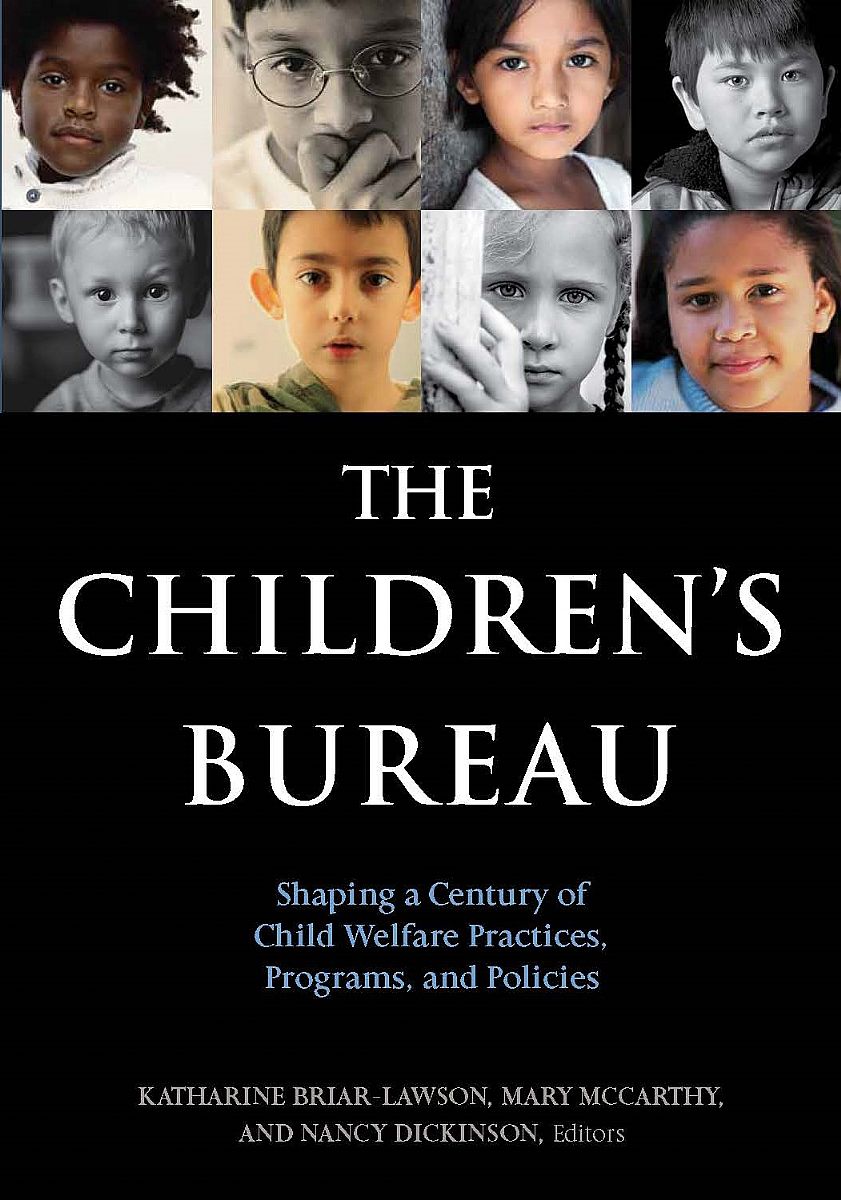
The Children’s Bureau
Shaping a Century of Child Welfare Practices, Programs, and Policies
Editors: Katharine Briar-Lawson, Mary McCarthy, and Nancy Dickinson
Page Count: 360
ISBN: 978-0-87101-446-7
Published: 2013
Item Number: 4467
Price range: $53.75 through $55.99
NASW members receive 10% discount on books and eBooks by entering their membership number at checkout.
Can your device download this eBook? Click here before purchasing! eBooks are available in single quantities only.
This edited book on the Children’s Bureau and child welfare delineates legacies and highlights the ways that the Children’s Bureau has influenced modern-day child welfare practices. As a centennial marker in honor of the Children’s Bureau, this book also charts future agendas and innovations that may guide more effective practice, programming, and policies. Indeed, social workers launched the Children’s Bureau in 1912. Originally in the Department of Labor, the Children’s Bureau has a century-long legacy linked to the social work profession. Ultimately, this book will serve as a testimonial to the durability of the Children’s Bureau, the changing nature of the challenges addressed, and the ongoing leadership role of social work.
The authors represent social work leaders in the field in child welfare policy, practice, and research. The book builds on NASW’s legacy and support for re-professionalization, research, and publications on child welfare and families in poverty. The chapters address the historical antecedents for a practice, program, or policy issue; the role of the Children’s Bureau; and wherever possible, evidence-informed principles, if not blueprints, to guide future practice, programs, and policy. In addition, as appropriate, each chapter addresses the role of social work and implications for future educational and professional social work reforms. The National Association of Social Workers and sister organizations such as The Council on Social Work Education, The Child Welfare League of America, and The Alliance for Children and Families offer visionary briefs charting future commitments and agendas for the 21st century.
Preface by Joe Bock and Elizabeth J. Clark
Chapter 1: Lessons Learned and the Way Forward
Nancy Dickinson and Richard Barth
Chapter 2: Family-Driven and Community-Based Systems of Care
William Bell and David Sanders
Chapter 3: Addressing Poverty as a Child Welfare Strategy
David Berns, Katharine Briar-Lawson, and Won Hee Kim
Chapter 4: Family-Centered Practice
Miriam J. Landsman
Chapter 5: Nothing about Us, Without Us: Meaningful Youth and Family Engagement in Child Welfare
Nicole Bossard, Sara Munson, Angela Braxton, Debra Conway, Benjamin Muhammad, and Gerald P. Mallon
Chapter 6: Ensuring a Successful Transition to Adulthood for Foster Youths
Roxana Torrico Meruvia
Chapter 7: Paradigm Shifts in Child Protection: From Investigation to Family Support
Brenda G. McGowan
Chapter 8: Prevention of Child Maltreatment Fatalities
Theresa M. Covington and Michael Petit
Chapter 9: Trauma-Informed Child Welfare Practice
Virginia C. Strand
Chapter 10: Serving Families with Co-occurring Challenges
Brenda D. Smith
Chapter 11: Social Work Traineeship Programs
Gary R. Anderson, Kathleen Coulborn Faller, and Robin Leake
Chapter 12: Social Work Education in Tribal and Urban Indian Child Welfare Settings
Virginia Whitekiller, Katharine Cahn, Heather Craig-Oldsen, and James Caringi
Chapter 13: Workforce and Leadership Development
Katharine Cahn, Freda Bernotavicz, and Cathryn Potter
Chapter 14: Knowledge Management and Leadership Development in Child Welfare
Nancy C. McDaniel and Charmaine Brittain
Chapter 15: University-Agency Partnerships to Advance Child Welfare
Joan Levy Zlotnik
Chapter 16: Envisioning the Future: Trends, Challenges, and Opportunities
Anita Light, Christine James-Brown, Cecilia Fiermonte, ElizabethClark, and Julia M. Watkins
Chapter 17: Child Welfare for the 21st Century: Organizational and Practice Imperatives
Mary McCarthy, Katharine Briar-Lawson, and Nancy Dickinson
About the Editors
About the Contributors
Index
Katharine Briar-Lawson PhD, LMSW, is dean, professor, and co-principal investigator, national Child Welfare Workforce Institute, School of Social Welfare, University at Albany, State University of New York.
Nancy S. Dickinson, MSSW, PhD, is clinical professor and director, National Child Welfare Workforce Institute, School of Social Work, University of Maryland, Baltimore.
Mary McCarthy, PhD, LMSW, is director, Social Work Education Consortium and coprincipal investigator, National Child Welfare Workforce Institute, School of Social Welfare, University at Albany, State University of New York.
Gary R. Anderson, PhD, Michigan licensed clinical and macro social worker, is director and professor, Michigan State University School of Social Work, East Lansing, Michigan.
Richard P. Barth, PhD, MSW, is dean and professor, University of Maryland School of Social Work, Baltimore.
William C. Bell, PhD, is president and chief executive officer of Casey Family Programs in Seattle, and currently resides in Sammamish, WA.
Freda Bernotavicz, MS, is senior research associate, Muskie School of Public Service, University of Southern Maine, Portland, ME.
David A. Berns, MSW, LCSW, MPH, is director of the District of Columbia Department of Human Services, Washington, DC.
Nicole Bossard, PhD, is president of TGC Consulting, Inc. and a senior consultant at the National Resource Center for Permanency and Family Connections.
Angela Braxton is a consultant and parent partner at the National Resource Center for Permanency and Family Connections.
Charmaine Brittain, PhD, is senior associate, Butler Institute for Families, University of Denver.
Katharine Cahn, PhD, MSW, is executive director, Child Welfare Partnership, Portland State University School of Social Work, Portland, OR.
James C. Caringi, PhD, MSW, is MSW program director and associate professor, University of Montana School of Social Work, coordinator of Qualitative Research National Native Children’s Trauma Center Institute for Educational Research and Service, Missoula, MT.
Elizabeth J. Clark, PhD, ACSW, MPH, is former chief executive director, National Association of Social Workers, Washington, DC.
Debra Conway is a child welfare consultant specializing in parent and community partnerships.
Theresa M. Covington, MPH, is executive director, National Center for the Review and Prevention of Child Deaths, Michigan Public Health Institute, Okmemos, MI and Washington, DC.
Heather Craig-Oldsen, MSW, CSW, is associate professor, program director, and chair of the Social Work Department and principal investigator of the Siouxland Indian Child Welfare Traineeship Project, Briar Cliff University, Sioux City, IA.
Nancy S. Dickinson, MSSW, PhD, is clinical professor and director, National Child Welfare Workforce Institute, University of Maryland School of Social Work, Baltimore.
Kathleen Coulborn Faller, PhD, ACSW, Michigan licensed clinical and macro social worker, DCSW, is Marion Elizabeth Blue endowed Professor of Children and Families, director, Family Assessment Clinic, University of Michigan School of Social Work, Ann Arbor.
Cecilia Fiermonte, JD, is child welfare policy director, Alliance for Children and Families, Washington, DC.
Christine James-Brown is president and chief executive offi cer of the Child Welfare League of America, Washington, DC.
Won Hee Kim, MSSW, is a doctoral student at Case Western Reserve University, Mandel School of Applied Science, Cleveland.
Miriam J. Landsman, PhD, is associate professor of Social Work and executive director of the National Resource Center for Family Centered Practice at the University of Iowa, Iowa City.
Robin Leake, PhD, is director, Research and Evaluation, Butler Institute for Families, University of Denver.
Anita Light, CAE, is deputy executive director, National Association of Public Child Welfare Administrators, Washington, DC.
Gerald P. Mallon, DSW, is the Julia Lathrop Professor of Child Welfare and executive director of the National Resource Center for Permanency and Family Connections at the Silberman School of Social Work at Hunter College in New York City.
Nancy McDaniel, MPA. Director of Consultation and Capacity Building, Butler Institute for Families, University of Denver, Denver, Colorado.
Brenda G. McGowan, PhD, LMSW, is professor, James Dumpson Chair of Child Welfare Studies, Fordham University Graduate School of Social Service, New York.
Roxana Torrico Meruvia is senior practice associate, National Association of Social Workers, Washington, DC. Meruvia conducts research and develops written products on issues related to children, youths and families. She has authored several publications related to child welfare specifically on the topic of youths aging out of foster care. She also has several years of experience working with diverse, low-income youths and families in the nonprofit and public systems.
Benjamin Muhammad is a former foster care youth and a staff member at the National Resource Center for Permanency and Family Connections.
Sara Munson, MSW, is the national dissemination coordinator for the National Child Welfare Workforce Institute at the University at Albany School of Social Welfare.
Michael Petit, MSW, is president and founder, Every Child Matters Education Fund, Washington, DC.
Cathryn Potter, PhD, is executive director, Butler Institute for Families, Graduate School of Social Work, University of Denver.
David Sanders, PhD, is executive vice president of Systems Improvement at Casey Family Programs in Seattle.
Brenda D. Smith, PhD, is associate professor, University of Alabama School of Social Work, Tuscaloosa.
Virginia C. Strand, DSW, is professor and codirector, National Center for Social Work Trauma Education and Workforce Development, Graduate School of Social Service, Fordham University, New York.
Virginia Whitekiller, Ed.D, MSW, BSW, is associate professor, Northeastern State University, Department of Social Work, Tahlequah, OK.
Julia M. Watkins, PhD, is past executive director, Council on Social Work Education, Alexandria, VA.
Joan Levy Zlotnik, PhD, ACSW, is director, Social Work Policy Institute, National Association of Social Workers, Washington, DC.
This centennial book brings together a national roster of child welfare experts from academia and practice to document the significant contributions of the Children’s Bureau to U.S. policy development for children and families. Highlighting foster care developments, chapters illuminate for the reader the complexities of the system as it evolved from a tradition of ‘rescue and punishment,’ deeply seeped in racial inequities, to current efforts of advancing progressive policies that aim to correct systemic inequities, promote empirically based approaches that recognize the significance of culture in services planning, and affirm that the well-being of children is inextricably linked to the well-being of families and communities. The book makes an important contribution to the child welfare literature by documenting how far we have come as a nation in addressing the needs of dependent children and is an invaluable reference volume and a supplementary child welfare textbook.
Alma J. Carten, PhD, ACSW, LCSW
Associate Professor
New York University Silver School of Social Work
As we celebrate the 100-year anniversary of the Children’s Bureau, we welcome this edited book on child welfare. By delineating some of the legacies and illustrating the ways that the work of the Children’s Bureau has influenced modern-day child welfare practices, this book is a thought-provoking resource for practice and program improvements. We hope the reader will be inspired by the passionate commitment and a legacy of leadership of those serving in child welfare and will think carefully about new priorities and directions that will guide our work into our next century of service.
The social work profession has long identified child welfare as a core field of practice, as seen by the focus of the earliest social work agencies on “child and family welfare.” Indeed, passionate and visionary social workers launched the U.S. Children’s Bureau in 1912 to address the most critical issues affecting children and families. The Children’s Bureau has a century-long history linked to the profession and looks forward to setting the stage as a leader for the next century of serving children and families.
Current Children’s Bureau programs are designed to promote the safety, permanency, and well-being of all children – including those in foster care, available for adoption recently adopted, abused, neglected, dependent, disabled, or homeless – and to prevent the neglect, abuse, and exploitation of children. These key goals of child welfare practice – and the organizational and workforce conditions needed to achieve them – are addressed in this book. The book focuses attention on the Children’s Bureau’s commitment to building and using evidence- informed and culturally relevant practice.
The historical policy and practice backdrop for child welfare innovations in the 21st century offer a fitting framework for linking some of the future work in child welfare to the origins of the Children’s Bureau. Important issues are identified, such as unemployment and poverty and the need for more innovations involving poor, minority, and disenfranchised families, who often live in communities with few resources and beset by complex social and economic challenges. By delineating the challenges and opportunities that lie ahead, we hope that this book will chart future agendas and innovations that may guide more effective practice, programming, and policies.
Joe Bock, MSW
Acting Associate Commissioner
Children’s Bureau
Administration for Children and Families
U.S. Department of Health and Human Services
—————————–
For generations, social workers have cared about children and their welfare. Many of the earliest social work and public health initiatives centered on the needs of children and how society could best care for and support them. At the forefront of these efforts has been the Children’s Bureau.
The Children’s Bureau grew out of the experiences of the settlement house movement and the first schools of social work, which took root at the turn of the last century. These early pioneers of social work were joined by leaders in the labor movement and other social activists who saw a federal role for protecting children and promoting their health and safety. Importantly, four of the first five heads of the Children’s Bureau, covering its first 50 years, were social workers.
The first director, Julia Lathrop (1912-1921), launched studies to identify what services and interventions were needed. She stated in her first annual report that the Bureau was to serve all children, to try to work out standards of care and protection that would give every child a fair chance in the world (U.S. Department of Health, Education, and Welfare, 1962).
Grace Abbott, the second director, served during the years 1921-1934. She was a strong advocate for maternal and child health programs, overseeing the initiation of the Sheppard-Towner Act (P.L. 67-97), an early public commitment to community-based interventions for infants and their mothers, which led to the decline of infant mortality.
From 1934 to 1952, Katherine Lenroot served as head of the Children’s Bureau, guiding its work through the Great Depression, the passage of the Social Security Act of 1935 (P.L. 74-271), and the second World War. Although she was involved in framing the Aid to Dependent Children program, only the child welfare provisions of the Social Security Act ended up in the Children’s Bureau. The administration of the Aid to Dependent Children program was housed in the new Bureau of Public Assistance.
Following Lenroot was Martha Eliot, a pediatrician who had run the Emergency Maternal and Infant Care program during World War II. Katherine Oettinger, who came to the Children’s Bureau after serving as dean of the Boston University School of Social Work, was the fifth head, serving from 1957 until 1968. She was a strong advocate for the Children’s Bureau in Congress, successfully increasing the Bureau’s budget and strengthening its programs (NASW Foundation, n.d.).
Many of the areas of focus in the early days of the Children’s Bureau – juvenile justice, child labor, maternal and child health, prevention of disability, and elimination of infant mortality – eventually became major programs within different federal agencies. An important factor relating to the work of the Children’s Bureau is that it has always been interdisciplinary, and from the start of federal child welfare services, there was support for the education and training of social workers and social work researchers.
The National Association of Social Workers (NASW and the Children’s Bureau also have a long and collaborative history. In the early 1960s, the social work research section of the newly formed NASW was called upon to work with the Child Welfare League of America to develop a research agenda for child welfare. The Children’s Bureau has supported both individual field-initiated research studies and research centers over the years. This has led to the more recent implementation centers, quality improvement centers, and evidence-based home visiting programs.
The NASW Press is pleased to publish this book. It is one more indicator of the connections between NASW and the Children’s Bureau, and another reflection of the strong role that the social work profession has played from the beginning both with and within the Children’s Bureau. Organized and edited by Katharine Briar-Lawson, Mary McCarthy, and Nancy Dickinson, it showcases the continued social work commitment to the field. The 17 broad-ranging chapters, authored by current child welfare leaders, address the many practice and policy issues that make up child welfare service delivery. In doing so, they create a modern vision for family-driven and culturally congruent systems of care. The Children’s Bureau: Shaping a Century of Child Welfare Practices, Programs, and Policies is a testament to the complexity of child welfare today, and it sets a stage for the work that the Children’s Bureau can, and must, undertake in its second century.
Elizabeth J. Clark, PhD, ACSW, MPH
Executive Director
NASW