
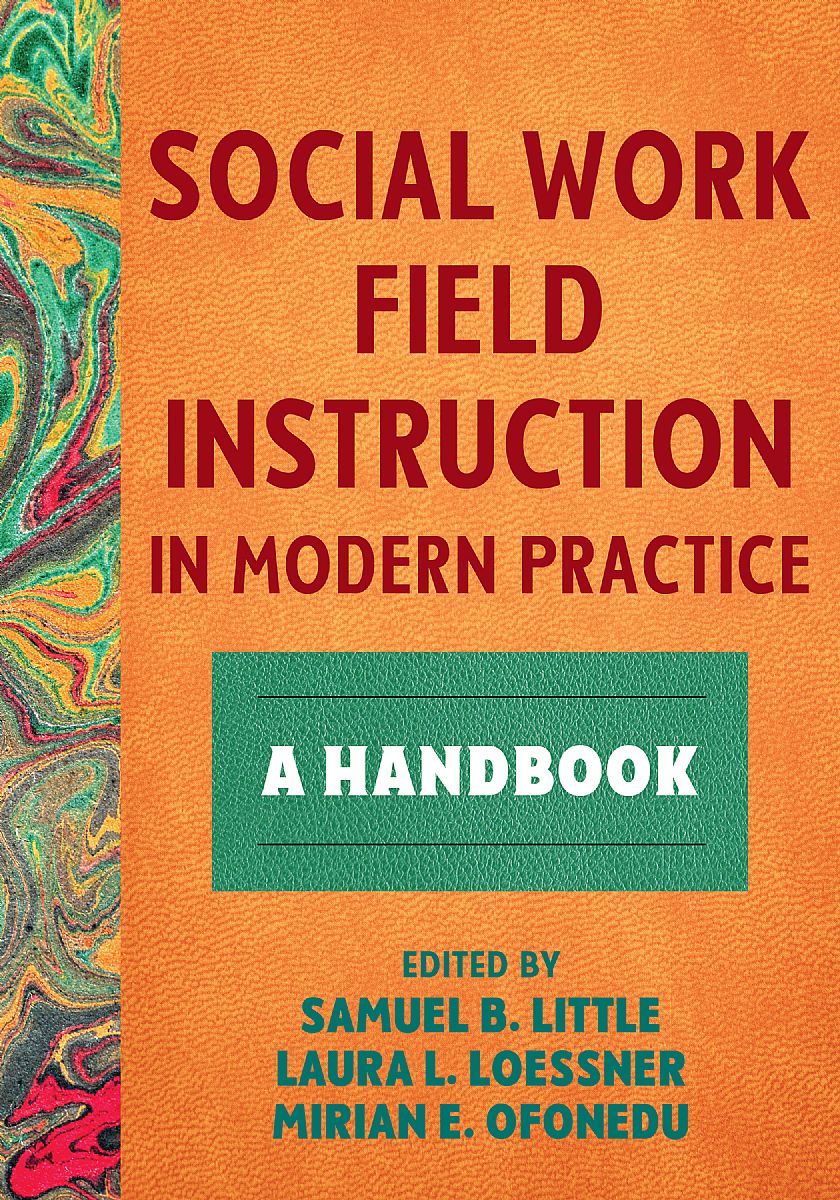
Social Work Field Instruction in Modern Practice
A Handbook
Authors: Samuel B. Little, Laura L. Loessner, and Mirian E. Ofonedu
Page Count: 236
ISBN: 978-0-87101-621-8
Published: 2025
Item Number: 6218
Price range: $41.43 through $44.61
NASW members receive 10% discount on books and eBooks by entering their membership number at checkout.
Can your device download this eBook? Click here before purchasing! eBooks are available in single quantities only.
Social work field instruction is evolving rapidly, particularly since the onset of the COVID-19 pandemic. Social Work Field Instruction in Modern Practice: A Handbook serves as an innovative resource for directors of field education, faculty liaisons, field instructors, task supervisors, and other professionals whose responsibilities are to prepare students for their roles after graduation. Drawing from experiences across the spectrum of field education placements, the authors endeavor to modernize and unify best practices in the field by elevating the conversation around inclusivity, adapting the latest technological advances, and harnessing the workforce development potential of social work field education to move the profession toward meeting the Grand Challenges for Social Work.
Throughout, real-world experiences and case studies offer insight into expanding the online educational environment, using a trauma-informed approach to field education, and increasing international placements and partnerships. The authors prepare students for engaging in community partnerships with diverse populations and developing critical thinking and skills. Further, as both students and field instructors are at high risk of burnout, the authors offer strategies for self-care, mindfulness, and achieving work–school–life balance.
The authors provide concrete guidelines and activities for field educators that will enhance their knowledge of various forms of accessibility, including recruitment, orientation, and field seminar, with the goal of creating an environment where all students can flourish.
In a rapidly changing profession that requires more advanced skill sets to satisfy performance expectations by social work agencies, this book aims to inspire a recalibration of field education roles to ensure students receive a world-class field experience.
Introduction: Field Is the Heart of Social Work Education
Samuel B. Little
Chapter 1: Social Work Field Education during COVID-19
Samuel B. Little, Laura L. Loessner, and Caroline Harmon-Darrow
Chapter 2: Social Work Field Education: Seeking Balance Inside and Outside
Janice Davis
Chapter 3: Preparing Students to Engage with and in Culturally Diverse Communities
Mirian E. Ofonedu and Wendy Jones
Chapter 4: Infusing Cultural Humility in Social Work Field Education through the Development of Community Partnerships
Roslynn Scott-Adams and Danielle S. Parker
Chapter 5: Prioritizing Cultural Humility in a Social Work Field Education Seminar
Laura L. Loessner
Chapter 6: Conceptualizing Accommodations for Students with Diverse Needs in Field
Margaux Delotte-Bennett and Lynda Myers
Chapter 7: Field Placements Serving Survivors of Human Trafficking
Nadine Finigan-Carr and Caroline Harmon-Darrow
Chapter 8: Service Placements with Persons Experiencing Homelessness
Donald Burnes and Samuel B. Little
Chapter 9: Trauma-Informed Field Education: Preparing Students for Practice
Molly Everett Davis
Chapter 10: Burnout and Empowerment of Field Instructors
Jennifer Siegel, Lauren McCarthy, Orrin Ware, Sol Baik, and Ivana Alexander
Chapter 11: Mindfulness and Self-Care in Social Work Field Instruction
Shanza Isom
Chapter 12: Field Education in Small Towns and Rural Communities
Kerri Shaw and Temi Chohan
Chapter 13: International Field Placements: Perspectives from Rajagiri College of Social Sciences (Autonomous), Kerala, India
Kiran Thampi, I. P. Sunirose, and Caroline Long
Chapter 14: Social Work Practice Learning in England
Jackie Yaskey
Chapter 15: Special Considerations for Online Social Work Programs: Establishing and Maintaining Quality Field Education across Distance and Time Zones
Beverly Araujo Dawson, Clark Shah-Nelson, and Matthea Marquart
Chapter 16: Field Education Internship Management Systems: Data Collection, Placement Assistance, and Statistical Reporting
Kristen Mitchell Samuels
Conclusion: Advancing Field Education through Collaborative Partnerships
Samuel B. Little
Samuel B. Little, PhD, is the associate dean emeritus for field education at the School of Social Work, University of Maryland, Baltimore; an associate adjunct professor at Howard University’s School of Social Work in Washington, DC; and founding president of the National Alliance for Resident Services in Affordable and Assisted Housing. He has experience in directing field education programs, combined with administering public housing programs globally, having served as associate deputy director at the Housing Authority of Baltimore City, executive director of resident services at the District of Columbia Housing Authority, and executive vice president for resident and community services at the Philadelphia Housing Authority. He has managed research projects on public housing topics, collaborated with foundation officials on cutting-edge capacity building programs to enhance the well-being of families, prepared testimony for Congressional hearings, and developed affordable housing policies and redevelopment plans. Dr. Little previously served as executive vice president of the Alliance Network based in Denver, Colorado. In this role, he developed community-based partnerships in Central America and partnered with redevelopment organizations to transform blighted communities into neighborhoods of choice while creating programs that provide access to education, health, and employment. Dr. Little is a member of the editorial board of the Journal of Human Service Organizations: Management, Leadership and Governance. He speaks regularly at public housing and social work conferences on capacity building programs for families. He also serves as an independent third-party monitor for resident council elections and conducts certification training for affordable housing agencies. The National Association of Social Workers Foundation honored Dr. Little in 2024 as a Social Work Pioneer. This prestigious award recognizes him as a powerful advocate for equitable public housing, and for his contributions to field education and social work research.
Laura L. Loessner, LICSW, LCSW-C, is a clinical associate professor and director of field education at the School of Social Work, University of Maryland, Baltimore, where she is responsible for the field education curriculum and the academic and administrative functions of practicum experiences for more than 850 students, in 745 community partnerships with more than 4,000 field instructors. In 2019, Ms. Loessner led the development and launch of a new field seminar rooted in cultural humility and antioppressive practice for nearly 400 foundation-level MSW students that continues each year since its inception. More recently, she has worked to develop methods for preparing social work students for success in practicum and practice including simulations, learning labs and mentoring models of teaching for liaisons and field instructors. Ms. Loessner has served on the executive board for the Mid-Atlantic Consortium of Directors of Field Education for the past decade, is a board-approved clinical supervisor, and has been a licensed clinical social worker since 1996. In her 34 years of professional social work experience, Ms. Loessner has developed expertise in clinical intervention and supervision, nonprofit management, professional development, and experiential learning for MSW and BSW students while employing a “justice, equity, diversity, and inclusion” lens. Her work includes bias research at the Urban Institute and directing nonprofit organizations for interpersonal violence, special education, and community-based health and mental healthcare. For more than 18 years, Ms. Loessner has taught in the classroom and as a graduate social work field instructor in six different schools of social work.
Mirian E. Ofonedu, PhD, LCSW-C, is the director of training at the Maryland Center for Developmental Disabilities at Kennedy Krieger Institute. She is an associate professor at the School of Graduate Studies, University of Maryland, Baltimore, and in the Department of Mental Health, Bloomberg School of Public Health, Johns Hopkins University. She is also a faculty affiliate of the Johns Hopkins Wendy Klag Center for Autism and Developmental Disabilities and adjunct professor at the School of Social Work, University of Maryland , Baltimore. Dr. Ofonedu is a psychologist and a licensed clinical social worker, with a specialization in service to children, youth, and families. She is a fellow of the American Psychological Association (APA) and served as APA Division 37 program chair, coordinator for task force on diversity initiatives and liaison to the committee on international relations in psychology. Dr. Ofonedu currently serves as chair for APA Division 37 Diverse, Racial, Ethnic, and Multicultural Special Interest Group and is a mentor for the APA Global Psychology Alliance, Global Psychology Learning Leadership Institute. She is also a master trainer for the ACT Raising Safe Kids, a program developed and coordinated by APA and is a recipient of the Association of University Centers on Disabilities Multicultural Council Award for Leadership in Diversity and the Kennedy Krieger Institute Social Justice Award. Dr. Ofonedu contributes to the field through her clinical, research, and training expertise at local, state, national, and international levels. Her work, which spans more than two decades, is inspired by the core values of recognizing and building on the strengths and competencies that exist in a person, family, and community, and being culturally and linguistically responsive to each person’s unique needs for the purpose of creating a more just, inclusive, and equitable society for all.
Ivana Alexander, MEd, MSW, LICSW, is a doctoral candidate in social work at the University of Maryland, Baltimore. She is also an experienced social worker, providing treatment and intensive case management in both acute hospital and outpatient mental health settings.
Sol Baik, PhD, MA, specializes in gerontology. Her interests include social determinants of health, neighborhood contexts, health disparities, and community-based care for the aging population and people with dementia.
Donald W. Burnes, MAT, PhD, is the co-founder of the Burnes Institute for Poverty Research at the Colorado Center on Law and Policy. He is the author of three books on homelessness. He is currently working with a national group that is exploring possible ways to persuade people to change attitudes about those experiencing homelessness.
Temi Chohan completed a graduate degree in speech language pathology. She also completed a graduate assistantship in the Department of Social Work at Ohio State University. Her work focused on projects that addressed internal bias experience by healthcare workers. She is currently a speech language pathologist in Cleveland, Ohio.
Janice M. Davis, PhD, MSW, LCSW-C, is the director of clinical education at Howard University School of Social Work. Her research interests include health disparities, first-generation and nontraditional college students, and well-being. She has more than 31 years of clinical experience.
Molly Everett Davis, MSW, EdD, A-CTTP, is a past associate professor in the Department of Social Work, George Mason University. She has been a Council on Social Work Education site visitor and has expertise in field education, gerontology, trauma-informed organizational change, cultural competency, and disaster behavioral health.
Beverly Araujo Dawson, MSW, PhD, is a professor in the School of Social Work at Adelphi University and the program director of the Online MSW Program. Her research discrimination on health disparities among Latinx individuals.
Margaux Delotte-Bennett, MSW, LICSW, is the director of field education for the baccalaureate and master’s programs at Gallaudet University’s Department of Social Work. Her work experience has focused on the needs of youth and young adults’ physical well-being, sexual health, homelessness, and LGBTQ+ human rights. She promotes accessibility for social work students who are deaf and hard of hearing, deafblind, and deaf+ (students who are deaf and have other disabilities or diagnoses).
Nadine M. Finigan-Carr, PhD, is a prevention research scientist focused on the application of behavioral and social science perspectives to research on contemporary health problems, especially those that disproportionately affect people of color. She is an expert on minor human trafficking and sexual exploitation. Dr. Finigan-Carr also is executive director of the Center for Violence Prevention University of Maryland, Baltimore, and the author of Linking Health and Education for African American Students’ Success (Routledge Press).
Caroline Harmon-Darrow, PhD, MSW, is an assistant professor at the Rutgers University School of Social Work. A community mediator and nonprofit leader for 24 years, she researches conflict resolution and other interventions to reduce violence, victimization, and incarceration.
Shanza A. Isom, MSW, is director of engaged transformative learning at the School of Social Work, Virginia Commonwealth University. Her areas of expertise include social work field education, holistic well-being, self-care, and mindfulness. She regularly facilitates workshops and delivers presentations to faculty, students, the community, and local/regional organizations.
Wendy Jones, MEd, MSW, is an assistant professor at the Center for Child & Human Development, Center for Excellence in Developmental Disabilities, Georgetown University. Ms. Jones’ clinical experiences with families and children from marginalized communities inform her teaching approaches and content with first-year medical students in community-based settings.
Caroline Long, PhD, retired as an associate professor, School of Social Work, University of Maryland, Baltimore, where she chaired the children specialization and directed the global engagement program. She also chaired the IV-E for Public Child Welfare Education Consortium for Maryland.
Matthea Marquart, MSSW, is the assistant dean of online education at the Columbia University School of Social Work, where she leads a team responsible for the online MSW program. Her interests are inclusive and innovative teaching, online education, social work education, and faculty development.
Lauren P. McCarthy, PhD, MSW, LCSW, received her PhD from the School of Social Work, University of Maryland, Baltimore, in 2022. Her research interests lie in ensuring equitable access to quality mental healthcare for all children and their families to reduce the need for residential treatment settings.
Lynda Rae Myers, PhD, MSW, LCSW-C, is a retired assistant professor at Gallaudet University. She is third-generation deaf/hard of hearing. She has served as a social worker based in community social service agencies for more than 30 years, primarily serving the deaf; hard of hearing; and late deaf, coda, and deafblind communities and their families.
Danielle S. Parker, MSW, is director of social work field education at Coppin State University. In her role, she manages the field education office, coordinates students’ placement needs, and establishes new community partnerships. She enjoys working with students in assisting them with understanding the dynamic social work profession and sharing the importance of field education as the signature pedagogy.
Kristen Mitchell Samuels, EdD, MSW, MS, MEd, is the director of field education for the University of Phoenix’s fully online BSSW program. Her research interests include technology diffusion and best practices to develop, implement, instruct, evaluate, and support the field education curriculum.
Roslynn Scott-Adams, PhD, LCSW-C, is a clinical assistant professor at The Catholic University of America. She enjoys using her years of practice experience and love for the social work profession to help students begin to learn to practice social work. Since joining the National Catholic School of Social Service, she has focused on helping students embrace the idea of becoming culturally humble social work practitioners.
Clark Shah-Nelson, DBA, MA, has developed, taught, coordinated and managed distance online learning programs. Currently, he is assistant dean of instructional design and technology at the University of Maryland School of Social Work. His recent research publications focus on collaborative technologies and human resources management and knowledge-sharing technologies to foster virtual team productivity for globally dispersed workforces.
Kerri Shaw, MSW, LISW-S, CHW, is the community health worker lead for the Ohio University Ohio Alliance for Population Health. Shaw has 20 years of practice experience in rural southeast Ohio as a school social worker, counselor, program developer, and educator.
Jennifer Siegel, PhD, MSW, is assistant professor and field director at Calvin University. She received her doctorate in social work at the University of Maryland, Baltimore, under the mentorship of Dr. Nalini Negi. Her research is focused on contributing to the empirical and theoretical understanding of behavioral health outcomes of immigrant and refugee children and families. Specifically, her research goals are focused on understanding how structural conditions shaped by immigration status and ethnic minority status impact the health and behavioral health outcomes of immigrant and refugee children and families, including anxiety, depression, PTSD, and risky substance use behaviors. She also performs evaluation activities on programs for unaccompanied immigrant and refugee children, specifically evaluating program effectiveness and health and well-being outcomes of program participants.
I. P. Sunirose teaches courses in the School of Social Work at the Rajagiri College of Social Sciences in Mahatma Gandhi University, Kottayam. She has conducted research on child care and protection. Among her research interests are child rights, women in leadership, and family violence. She is a consultant to various forums and a member of anti–sexual harassment committees in both government and the corporate sector.
Kiran Thampi, MPhil, PhD, is the assistant professor in the Department of Social Work, Rajagiri College of Social Sciences, and also the assistant director of the Office of International Relations. He is currently the project lead, partnering with Israel and Australia, in the international project funded by IASSW. His research and publication interests include nongovernmental organizations, social audits, mental health of professionals and youth, and international social work.
Orrin Ware, PhD, MSW, is an assistant professor at the University of North Carolina at Chapel Hill School of Social Work. As an applied public health researcher with a background as a licensed clinical social worker, he has more than a decade of experience providing treatment services to people living with cancer, HIV, mental health disorders, and substance use disorders.
Jackie Yaskey, BA Hons, MA, DIPSW, SFHEA, is senior lecturer and program leader in social work at the University of Greenwich. Her areas of expertise include social work skills and practice learning, law and policy, values and diversity, social work theories and direct work with children, employability, and transition to professional social work practice. She is a senior fellow of the Higher Education Academy.
Introduction: Field Is the Heart of Social Work Education
Field education is a critical component of the foundation for educating social work professionals. It was an honor to serve in the forefront of field education as an Associate Dean at the University of Maryland School of Social Work (UMSSW) between 2010 and 2023. Drawing from experiences across the spectrum of field education matters, Social Work Field Education in Modern Practice: A Handbook will serve as a resource for faculty liaisons, field instructors, task supervisors, and other field education professionals whose responsibilities are to prepare students for important roles after graduation. They make up a valued network of field stakeholders around the country who are affiliated with the 533 accredited baccalaureate and 296 master’s programs.
The profession of social work is rapidly changing in response to the diverse needs of individuals, families, and communities that have become increasingly complex. They require the application of cutting-edge knowledge gained from research, evidence-based best practices, public policy formulation, revisions to Council on Social Work Education (CSWE) competencies, and requirements for licensure by boards of social work. Nonetheless, our aspiration as leaders in field education is to prepare students for practice in a rapidly changing world that not only requires increased skill sets to satisfy performance expectations by social work agencies, but also aims to accomplish the Grand Challenges for Social Work. To that end, this book hopes to inspire a recalibration of field education roles to ensure students receive a world-class field experience. Though daunting for some, this undertaking is necessary for all schools of social work.
Chapter authors are mavericks in the profession and represent schools of social work of varying size. They enabled the editors to incorporate relevant topics across explicit categories. Chapter 1 documents the impact of COVID-19 on field education and student agency assignments following an abrupt shift to virtual placements. Dean Samuel Little, Professor Laura L. Loessner, and Dr. Caroline Harmon-Darrow, who was previously at UMSSW, summarize the modified procedures and special assignments developed to accommodate students and agencies during the onset of the COVID-19 pandemic. Experiences from four additional schools are also cited, including changes that were implemented by the field programs at the University of Greenwich in London and Rajagiri College of Social Sciences (RCSS) in India.
In chapter 2, Dr. Janice M. Davis (Howard University School of Social Work) writes on the importance of seeking work–school–life balance. Emphasis is placed on students in a female-dominated profession and the multiple roles that women seeking education must fulfill. As head of household, caregiver, parent, and student, these women frequently juggle their responsibilities and strive for academic excellence. The chapter addresses the question: Is this a fair proposition? This may open one’s mind to equity and equality issues and concerns.
The authors of chapter 3 address the challenges facing specific populations and the context of addressing them in the field placement agency. Dr. Mirian E. Ofonedu (Kennedy-Krieger Institute) and Wendy Jones (George Washington University) focus on preparing students to engage in field through the development of community partnerships. The chapter addresses cultural knowledge in consideration of the cultural-political context, self-awareness and self-reflection in practice, and cultural skills acquisition. The chapter also presents what we know about the role played by field instructors in training students for work in diverse communities.
In chapter 4, Professors Roslyn Scott-Adams (The Catholic University of America) and Professor Danielle S. Parker (Coppin State University) show field instructors and students how to infuse cultural humility through the development of community partnerships. Studies are described with suggested actions for resolution.
Professor Loessner was the lead in developing the field seminar for foundation students and facilitators’ handbook at UMSSW. It is an integrative field seminar and is a critical component of the field education experience in helping students identify strongly with the social work profession, enhance critical thinking, and experience satisfactory overall field education (Fortune et al., 2018). Her experience is detailed in chapter 5.
Students requiring accommodations are increasingly attracted to social work. They have a desire to give back and serve those whose circumstances are similar. Professor Margaux Delotte-Bennett and Dr. Linda Meyers (Gallaudet University) are experts on Deaf Gain, a model for inclusive practice in social work field education. In chapter 6, they provide concrete guidelines and activities for field educators to use to enhance their knowledge of various forms of accessibility in terms of social work field preparation related to recruitment, orientation, and field seminar. Deaf Gain’s conceptualizations and reframing promote a learning environment where all students can flourish.
Much attention today is on human trafficking and homeless persons. These are also global challenges that are emphasized in the focus on the Grand Challenges for Social Work. In chapter 7, Dr. Nadine M. Finigan-Carr (Center for Violence Prevention, University of Maryland, Baltimore) and Dr. Caroline Harmon-Darrow (Rutgers University School of Social Work) introduce field placements serving survivors of human trafficking. They support the idea that human trafficking education through field education is a critical method for filling the gaps between the need to provide effective services to survivors, and the current knowledge base in the profession.
In chapter 8, Dr. Donald W. Burnes (University of Denver) and Dean Little (UMSSW) combine programmatic experiences and collective insight about serving homeless families. They raise three questions used to help frame a choice for selecting an intern for a placement serving homeless families. The interns also are asked to make tough choices between engaging in direct services to those already experiencing homelessness, examining one of the systems that create homelessness and how to change it, and ascertaining what should be done to preserve measures. Hope Village in Baltimore is presented as an innovative model to address housing instability and homeownership, two of the biggest barriers to persistent homelessness.
The role of trauma in field education is the focus of chapter 9, authored by Dr. Molly Everett Davis (formerly at George Mason University). She proposes ways to prepare students for this area of practice. The chapter introduces the concept of trauma-informed field education and describes the role of trauma in the structure and practice designed to implement field education. Attention is paid to gatekeeping function, understanding what is a “trigger,” and meditation. Case samples are provided as additional resources.
Field instructors play a pivotal role in the provision of field education. They, like social workers in general, are especially at risk of burnout due to challenges associated with high work demand without resources to offset such demands, exposure to distressing individual interests and social problems, and internal conflict associated with service capacity (Brown et al., 2019; Wagaman et al., 2015). Social work field instructors may be at particular risk for burnout due to their added responsibilities for mentoring and supervising students. Dr. Orin Ware, a postdoc at Johns Hopkins University, and UMSSW PhD candidates Jennifer Siegel, Lauren P. McCarthy, Sol Baik, and Ivana Alexander analyze data collected for field instructors who completed the burnout subscale of the Professional Quality of Life Scale. The data they present in chapter 10 provide insight into the level of burnout among the sample of field instructors, as well as workplace characteristics associated with higher burnout scores. They offer specific strategies for universities to help prevent burnout and empower social work field instructors. Professor Shanza A. Isom (George Mason School of Social Work) covers self-care through mindfulness in social work field instructions in chapter 11. Mindfulness practice can facilitate “clinical skill development by fostering key therapeutic qualities such as attention, empathy, compassion, cognitive flexibility, self-awareness and responsiveness to client needs” (Gockel, 2015, p. 185). For this reason, we recognize the importance of being present with and for our clients. Case samples are offered to help students develop critical reflection, intentional skills, and supporting self-care techniques. Field students have the opportunity to test broadly what they learn in the classroom, but for students placed in rural areas and small towns, the value of a field placement and its learning opportunities is amplified. Students have unique learning opportunities and challenges around diversity; ethical dilemmas and dual relationships; competency development across macro, mezzo, and micro practices; and personal growth as professionals. Professor Kerri Shaw and Erin Lucas (Ohio University Department of Social Work) explore themes in current rural field education in chapter 12 and offer examples from the program and its students with the goal of preparing students to practice rural social work with competence, grounded in ethics and social work values.
Interest in international field placements is growing in schools of social work, and many MSW programs, including UMSSW, have established partnerships with universities in other countries. For several years, students at UMSSW have spent a semester at Greenwich University in London or Rajagiri College of Social Science (RCSS) in India. The colleges provide unique internships for advanced students. Dr. Kiran Thampi and Dr. I. P. Sunirose at RCSS, in collaboration with Dr. Caroline Long at UMSSW, discuss the RCSS–UMSSW model in chapter 13. India is moving forward to establish a council for social work, modeled on the CSWE in the United States. In circulation is a draft of the National Council of Social Work Bill (2020), which aims to regulate quality, flexibility, and autonomy in social work education and practice. The chapter sheds light on this evolution and process.
In chapter 14, the fascinating and distinctive history of social work practice learning in England is covered by Professor Jackie Yaskey at Greenwich University. The emphasis is on the significant change and reform during the past 20 years beginning with the development of the General Social Care Council (2001) and followed by the creation of the Social Work Reform Board (2010), the College of Social Work (2012), and the British Association of Social Work (2015).
Online social work programs have grown globally, and there are special considerations for establishing and maintaining quality field education across distance and time zones. In chapter 15, Professor Beverly Araujo Dawson (Adelphi University), Dr. Clark Shah-Nelson (UMSSW), and Professor Matthea Marquart (Columbia University) give attention to a range of considerations, including identifying the number of students in need of flexible field schedules; facing the challenge of locating remote field placements; helping field educators develop requisite skills to support online field education; and becoming comfortable and familiar with the use of emerging technologies such as videoconferencing, Zoom, collaborative technologies, and learning management systems. The authors also discuss innovative ways for online students to meet field hour requirements, seminar and site visits, support for remote structures, and field instructors. Case studies are provided and discussed.
Field education manages significant amounts of data and documentation. There are challenges in properly collecting information, retrieving and analyzing data, and converting information to infographics and other formats. Too often, field departments miss the opportunity to promote their important work because of these challenges. In chapter 16, Professor Kristen Mitchell Samuels (Arizona State University) explores field education management systems, underscoring the importance of data collection, placement assistance, and statistical reporting. Placement software is promoted to help programs manage the complexity of field placements. In this chapter, the needs commonly met through field placement software are outlined, and critical questions are asked regarding software selection.
In the conclusions, Dean Little connects the dots by emphasizing the relevance of these topics in modern times with swift changes in social work field education. More and more, we recognize field education as the signature pedagogy in social work and the heart of social work education. Field is where an essential connection takes place and enables students to begin to cross-pollinate in vivo practice.
REFERENCES
Brown, A. R., Walters, J. E., & Jones, A. E. (2019). Pathways to retention: Job satisfaction, burnout and organizational commitment among social workers. Journal of Evidence-Based Social Work, 16, 577–594. https://doi.org/10.1080/26408066.2019.1658006
Fortune, A. E., Rogers, C. A., & Williamson, E. (2018). Effects of an integrative field seminar for MSW students. Journal of Social Work Education, 54, 123–145. https://doi.org/10.1080/10437797.2017.1307149
Gockel, A. (2015). Teaching notes—practice presence: A curriculum for integrating mindfulness training into direct practice instruction. Journal of Social Work Education, 51, 682–690. https://doi.org/10.1080/10437797.2015.1076275
Wagaman, M. A., Geiger, J. M., Shockley, C., & Segal, E. A. (2015). The role of empathy in burnout, compassion satisfaction, and secondary traumatic stress among social workers. Social Work, 60, 201–209. https://doi.org/10.1093/sw/swv014